About Julian Sands and the Movies That Shape Us
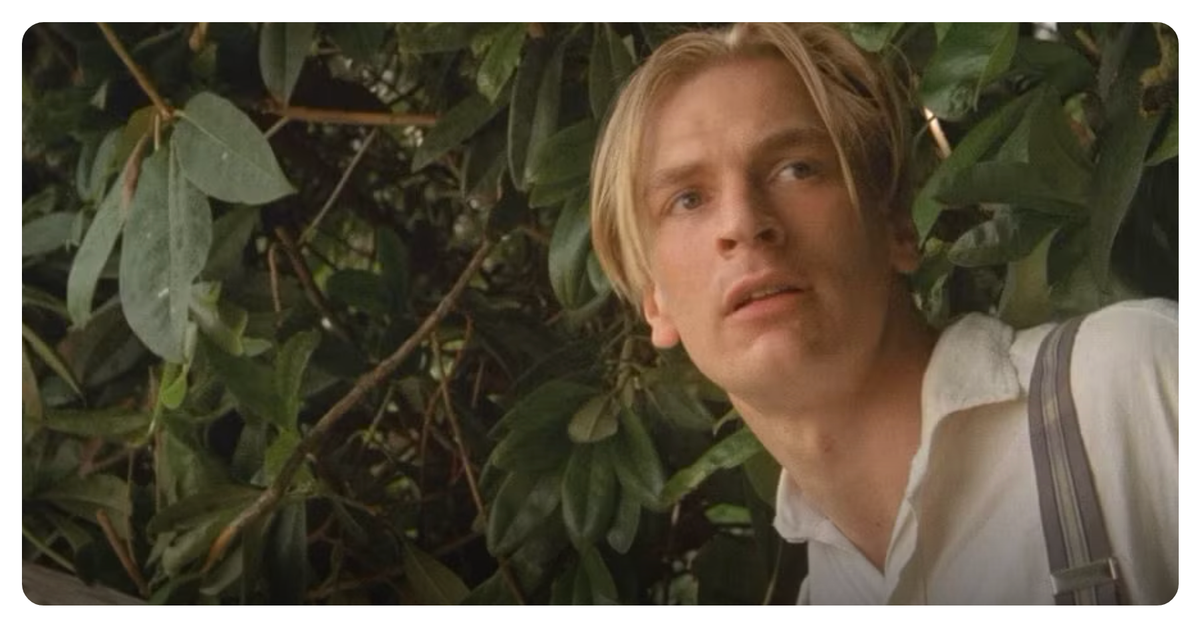
Last week I did what I do every couple of years or so and re-watched A Room With a View.
I first watched the movie in high school, several years after it came out in 1985. Its effect on me was that of a lit match on gasoline: it immediately ignited more or less my entire personality for the remainder of high school. I became obsessed with, in no particular order, the novels of E.M. Forster; each and every Merchant Ivory production; Helena Bonham Carter's hair; deceased homosexual British novelists; Rupert Graves; attempting an indefensible English accent that haunts me to this day. I was so dedicated to ARWAV cosplay that on one summer afternoon when I was seventeen I set out on a bike ride wearing not a helmet but a floppy hat to better approximate the fashions of Edwardian England. When the hat promptly began to fly off my head, I clamped one hand to it and put the other on the wrong brake, catapulted over my handle bars, and broke my jaw in two places.
When I watched ARWAV last week I didn't think about any of that. Instead, I thought about Julian Sands. In the movie, he plays George Emerson, the brooding, beautiful young man who woos Bonham Carter away from marriage to Cecil Vyse, an intolerable prig played by Daniel Day-Lewis. Sands as Emerson lends the film notes of lust and punk rock: he's laconic and blunt, unashamed of his desire, free with his body, and uninterested in conforming to societal norms. He's completely invigorating.
Three years ago, Sands died while on a hike in the California mountains; his body wasn't discovered for months. He was sixty-five years old and left behind a wife and three children.
This wasn't my first time watching ARWAV since Sands's death, but it hit differently. Each time I re-watch the movie I'm aware of how it shaped me, consciously and otherwise: I can trace certain speech patterns and inflections to the way the actors read their lines, and in their faces I can see expressions that I subconsciously ape even now. I sometimes think that movies imprint upon us like language does on children, teaching us how to speak and interpret the world. When Julian Sands went missing I was still on Twitter, and posted something about how his performance in A Room With a View created a new neural pathway in my brain.
That was a little florid, but true. Because there was something in his performance I hadn't seen anywhere else, and it changed me in a small but indelible way. It wasn't like having a crush—that was reserved for Rupert Graves, playing Bonham Carter's brother. It was more like learning a different and slightly unsettling way that desire and romance could manifest onscreen, and then in life.
Which is another way of saying that Julian Sands haunted me, and continued to haunt me (admittedly, this also owed to his subsequent choices in movies, Warlock and Boxing Helena among them). And watching him this time around, I was haunted by his loss, which registered more deeply than it had previously. I'm not sure why; perhaps it was that more time had passed, and allowed the fact of his death to settle in. Perhaps it's because I'm now three years older, and three years further removed from the adolescent brain that imagined young actors would always remain so.
I suppose I'm mourning Julian Sands as much as I'm mourning the passage of time. And yet A Room With a View renders him immortal. When I watch him, I feel immortal too, forever fifteen and enchanted, and unaware that one day I will break my jaw and he will die on a mountain. For one hour and fifty-seven minutes both of us are suspended, young, a little weird, and above all, impossibly golden.
What I'm Consuming This Week:
Reading: Tom Barbash's The Dakota Winters, a book that has been sitting on my night stand since 2019. It's fairly absorbing and I'm so far enjoying it.
Listening: The audiobook of Lena Dunham's Famesick. Raw, honest, occasionally very funny, and much better than I expected it to be.
Watching: Pacific Heights. Michael Keaton plays a psychotic con man who terrorizes Melanie Griffith and Matthew Modine as a pair of San Francisco yuppie gentrifiers and it's INCREDIBLE.