About Watching the Oscars While the World Burns
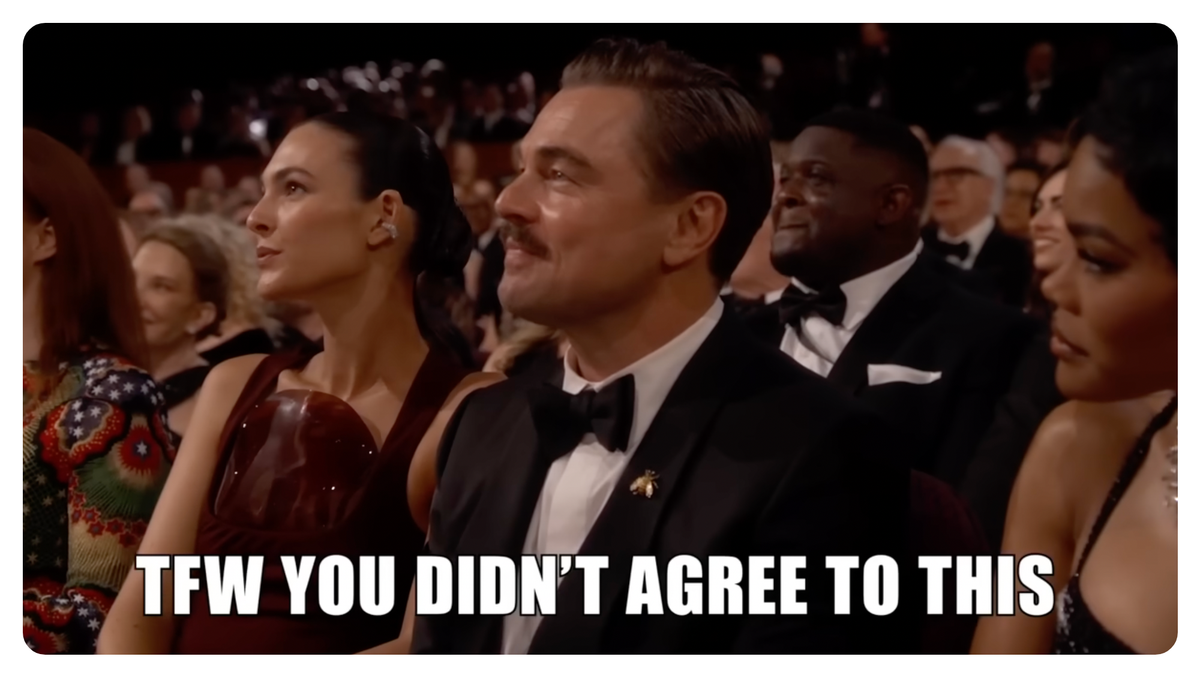
I belong to that subset of masochists who watch the Oscars beginning to end, year after year without fail. I once even found a way to watch when I was staying at a youth hostel in New Zealand, which was no small feat in the days before smartphones. I do this because I love movies and take perverse pleasure in watching overpaid people wear pretty clothes and engage in a collective tongue bath.
I'll accept a lot from an Oscar ceremony — lame presenter patter, physical assault, interpretive dancing while the names of the recently deceased flash across the screen. And this year's ceremony did deliver some welcome surprises: awards for Michael B. Jordan, Autumn Durald Arkapaw, Ryan Coogler, and Amy Madigan; an In Memoriam segment executed with a modicum of good taste. But even by my low, low standards, watching the Oscars this year felt like even more of a fool's errand than it normally does.
It can be easy to forget that many Hollywood people are also American citizens, but as I watched one after another accept their little gold statues, their acceptance speeches served as a dispiriting reminder. Not because of what was said, but what wasn't. A day or so before the ceremony, I read a Times op-ed arguing that actors should use their Oscar acceptance speeches to speak out against the fall of our democracy and our president's repulsive/criminal behavior. "It does make a difference if powerful famous people find the courage to speak out," wrote Daniel Kehlmann, the author of a book about the German film industry under Nazi rule. "It actually makes all the difference."
Given the smattering of "Be Good" and "ICE Out" pins worn at the Golden Globes, I'll admit that I had a sliver of hope that some of the winners would use the spotlight to say something that acknowledged the Hieronymus Bosch hellscape that passes for reality in the year 2026. Again, a fool's errand, I know, I know. And normally I'm not so deluded that I expect Oscar winners to excrete anything that might pass for substance. But these are not normal times, and they demand that any citizen of this country squeeze out a bit of courage, particularly those of us who are fortunate to have very little to lose.
And none of those fancy motherfuckers said anything. Not even Amy Madigan, who had the stones to remain seated and unsmiling, with her husband Ed Harris, during the standing ovation given to Elia Kazan at the 1999 Oscars. The only sustained acknowledgement of the "very chaotic, frightening times" that host Conan O'Brien alluded to came from the documentary maker David Borenstein, who used his acceptance speech for Mr. Nobody Against Putin to warn of the countless small acts of complicity that aid the fall of democracy; and Javier Bardem, who barked out a quick "no to war and free Palestine" before presenting the award for best international film. Reportedly, Sean Penn wasn't there to accept his Best Supporting Actor award because he was in Ukraine, a decision that spoke more loudly than anything said during the Oscar telecast.
After the ceremony, my friend Kristian texted a photo of Hamnet director Chloe Zhao's Oscars outfit, which looked like some kind of promo for the 13th season of American Horror Story. "Definitely my favorite look," he wrote. "It says, we just bombed a school in Iran, killing hundreds of children, let's party."
Yeah, the Oscars are supposed to be a party, not PBS News Hour. But I think I've finally reached the point where the ceremony feels less like a party than a wake: for an eroding Hollywood system, for bodies untouched by GLP-1s, for a time when choosing to stay silent on the world's biggest stage didn't feel like a default state of moral cowardice. Like any self-respecting masochist, I have my limits.