About 'Wuthering Heights'
It was towards the end of "Wuthering Heights" that I began to suspect I was going to hell, no matter that Jews don't believe in it. Cathy was on her death bed, expiring from septicemia, and Heathcliff was professing his love and sorrow. The woman next to me was weeping audibly, and I was laughing.
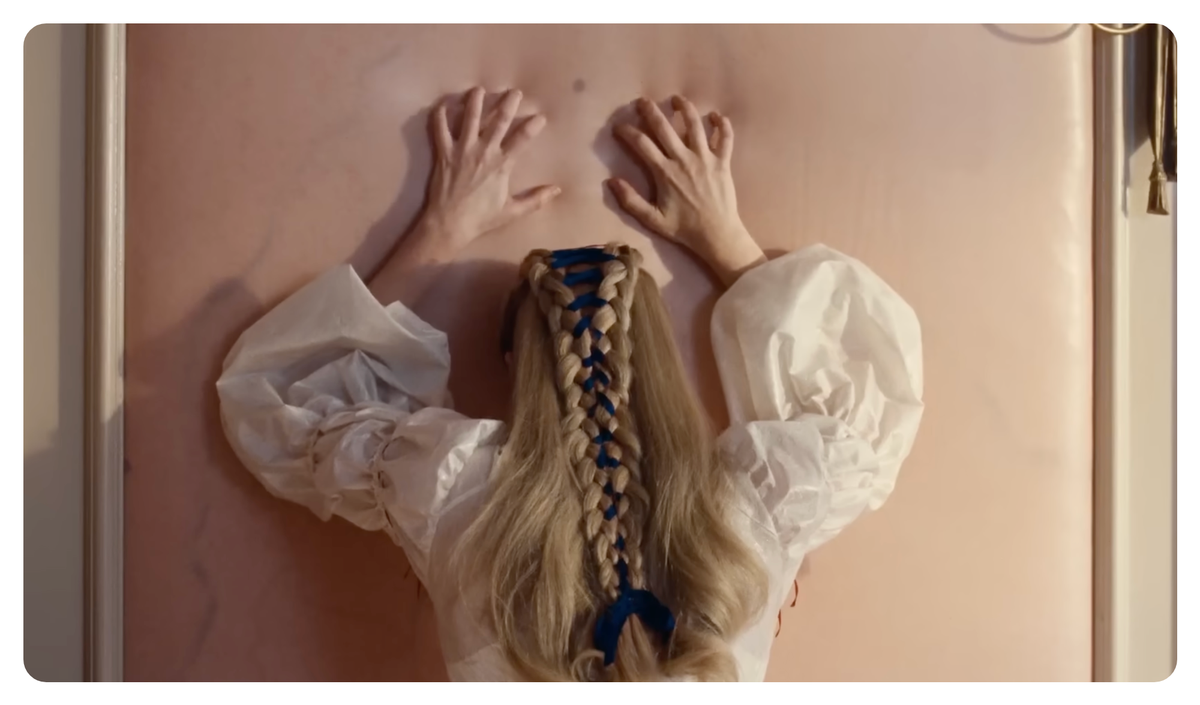
For the preceding two-plus hours, the movie had been commanding me to FEEL. It wanted me to feel its protagonists' passion, their every vexation, their smoldering horniness. It demanded that I marvel at a room wallpapered to resemble Cathy's skin (my mind drifted to Ed Gein); it asked me to buy two actors in their late 20s and mid-30s exhibiting the emotional maturity of teenagers; it ordered me to find its provocations as shocking as its director Emerald Fennell clearly did. This is sexy, sexy, sexy, the movie kept insisting. But the more it told me to swoon, the more I wanted to laugh. So by the time we got to Cathy's death bed, I was done. There was nothing left to do but give in.
I'm not a Wuthering Heights loyalist. I read the book for the first (and probably only) time a month ago. I understand why some people love and return to it again and again, but I found it to be an effective sleep aid. So I wasn't looking for a movie adaptation faithful to the book's every letter. I knew going in that Fennell had cut about 80 percent of its characters and at least 50 percent of its plot, and I knew this was a movie that inspired opinions, just as Fennell's previous two films had. If anything, I knew too much, since none of what I saw came as a surprise.
What did surprise me was how protective I wound up feeling of a book I didn't even like. Or rather the right of any book to be represented on screen in a way that conveys what's actually interesting about it. For me, what's interesting about Wuthering Heights is its theme of intergenerational violence (so much violence) and trauma, and how the relationship between Cathy and Heathcliff has little to do with romance and everything to do with obsession — I want the movie adaptation that shows us Heathcliff digging up Cathy's freaking grave, and the effect these two extremely tiresome people have on everyone who's forced to endure them. Of course, "interesting" is subjective, and what was reportedly interesting about Wuthering Heights to Fennell is how it made her feel when she read it for the first time as a teenager.
But what struck me is that for the story to work as a romance, Fennell had to excise so much about what makes the book's characters behave as they do — Heathcliff in particular is sanitized so that he's now more a man in love than a total asshole who abuses women and animals. That sort of whitewashing is kind of interesting to me, if only because it demonstrates the lengths filmmakers will travel to repackage something as a sweaty romance, and how little they trust audiences with so-called difficult material.
Two days after seeing "Wuthering Heights" I saw Pillion. It's a movie about a shy young gay man who enters into a BDSM relationship with a laconic, outrageously hot biker. It's sweet, funny, complex, and deeply moving, and refuses to sand off its characters' rough edges in the name of romance. Like "Wuthering Heights," it's an adaptation of a book about two people who ultimately can't be together. Unlike "Wuthering Heights," it didn't try to shock me, or tell me to feel anything other than what I was feeling, which was delight. You might even say that I swooned.