About Watching 'Marty Supreme' While Jewish
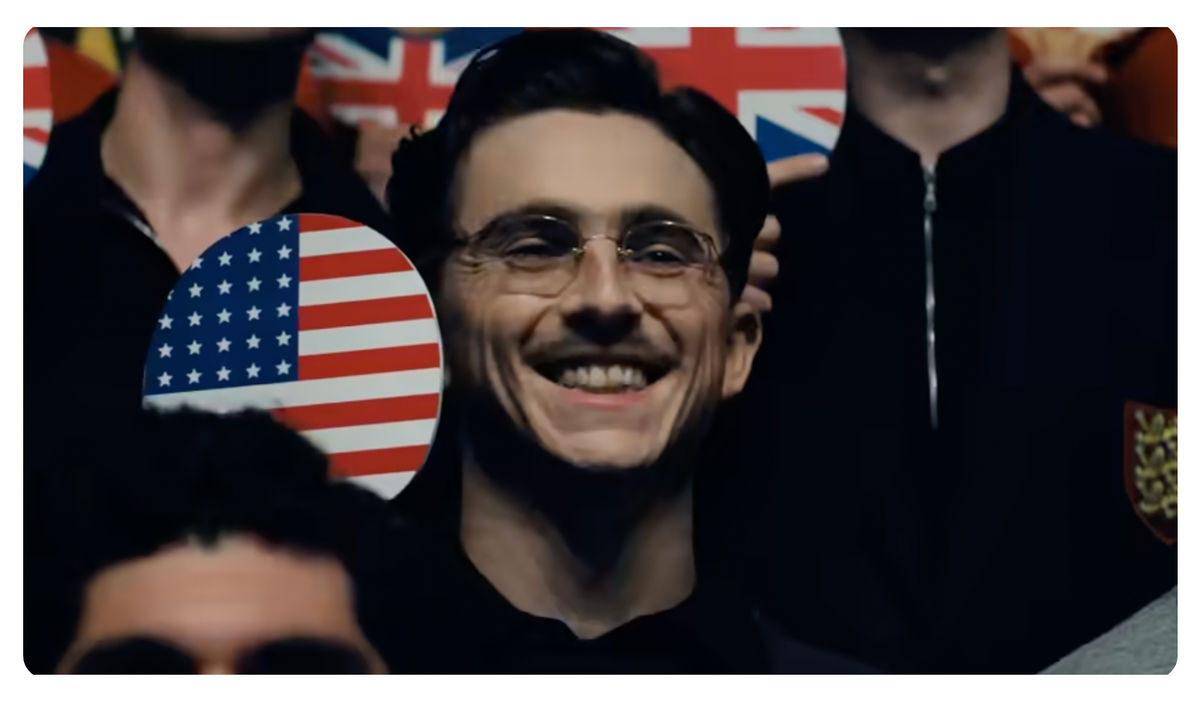
By the time I watched Marty Supreme two nights ago, I was already a little tired of it. The coverage that has attended it since its Christmas Day release has been as relentless as critics reported the movie's plot to be, and while I don't mind Timothée Chalamet as a screen presence, there's only so much branded merchandise and red carpet stunt dressing a person can be expected to endure.
But if I came to Marty Supreme preemptively annoyed, I also arrived curious. This was largely due to the discourse around the film's depiction of American Jewish identity, specifically in the postwar years. Some Jews don't like Marty Supreme because they contend that Marty — who is venal, greedy, money-obsessed, self-serving, and unconcerned with whomever he harms in his drive to become a world ping pong champion — represents every shitty stereotype that has been weaponized against the Jewish people for much of recorded history (minus the ping pong business). Some don't like the film because it refuses to portray Jews through the prism of historical victimhood, as many films are wont to do. In Marty Supreme, there is no model minority, no nebbish neuroticism, no Talmudic wisdom, and certainly no nice Jewish boy. And so the question about Marty Supreme has been, essentially, is it good for the Jews?
Marty Supreme was directed by a Jew (Josh Safdie) and stars several Jews (Chalamet, Fran Drescher, and a criminally underused Sandra Bernhard among them) — credits that have the same effect as a scene in which Marty protests, "I can say that, I'm Jewish" after making a crack about the Holocaust. So it's a film that has an undeniably Jewish identity. But I don't see it as a film about Jewish identity. I see it as a film about a driven, mostly terrible person who happens to be Jewish. Yes, Marty wears a Star of David necklace throughout the movie, and yes, he does declare that someone like him — a confident, unapologetic Jew — is Hitler's worst nightmare. He also gets called the k-word, and encounters some thinly veiled antisemitism in the form of a goyische pen tycoon.
Marty's Jewishness is inextricable from who he is, but it's also irrelevant: his real religion is his own self-interest. That's never more clear than the scene where he goads his friend Alojzy, a Holocaust survivor, to tell the pen tycoon a story about Auschwitz, all so that Marty can get a moment to eye-fuck the pen tycoon's wife. The scene serves as a commentary on Marty; on the post-Holocaust discrepancy between American and European Jews (for the former, it's a story; for the latter, a lived nightmare); and the way films do and don't treat the Holocaust. For me, it was the best scene in a movie that I didn't like.
There are a lot of reasons I didn't like Marty Supreme (don't get me started on its treatment of its female characters, Jewish and otherwise). But its depiction of American Jewish life in 1952 isn't one of them. To say that movies can't show individual Jews as deeply flawed human beings — that portraying one of us as a total shit will somehow make the rest of us guilty by association — takes us to a historically very problematic place. I didn't need Marty to be a good person, or a "good Jew," whatever that is. I just needed him to be a nuanced, interesting person I wanted to ride along with for two and a half hours, and he wasn't.
So is Marty Supreme good for the Jews? It depends on the Jew. For this Jew, it was neither. Mostly, it was a reminder that no amount of ping pong-themed red carpet dressing can compensate for a deficit in good writing.