About My Face
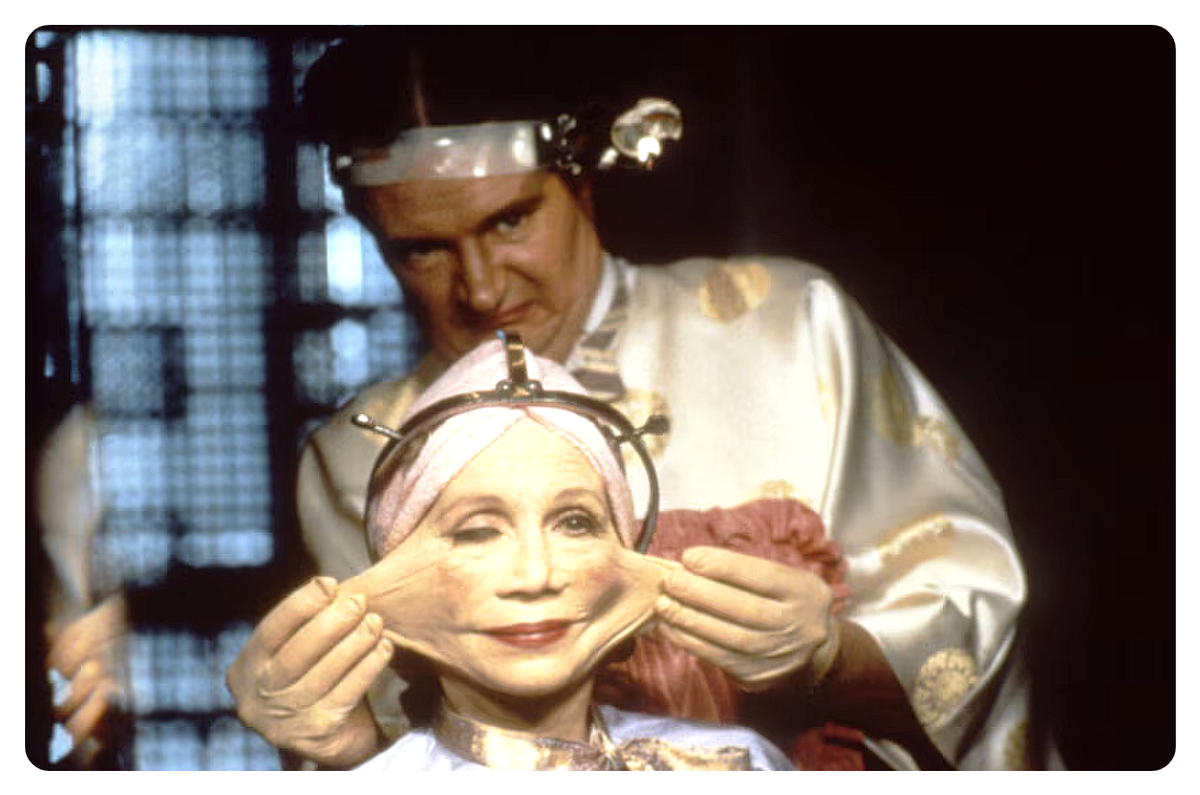
This past December, a very good thing happened to me: I got a two-book deal for two novels I've been writing for the better part of the past decade. My publisher, Bloomsbury, asked me for a headshot they could use to accompany the announcement. This quite reasonable request precipitated a not as good thing, which was me scrolling through my phone to find something that a) could be interpreted as an author photo and b) didn't trigger my pathological aversion to visual depictions of my own face.
I will spare you a play-by-play of the various life events that have aided and abetted my complicated relationship with my appearance; perhaps it's enough to say that I grew up as a female societally conditioned to seek male approval, and that, as Richard Hell once sang, "it's such a gamble when you get a face."
Figuring out how I wanted the world — or at least a certain segment of the publishing industry — to see me brought this all to the fore. And then it brought me to Facetune.
I'd previously thought of Facetune as the candy cigarette of the plastic surgery world: try the facsimile, advance to the hard stuff. As such, I had zero interest in it until I found myself trapped in the vice grip of my own vanity and insecurity. I uploaded a selfie to the app and began playing around, erasing this, smoothing that, until my face felt like one of those fully customizable Converse sneakers. One face, infinite options, most of them bad! Then I hit the "enhance" feature, and suddenly, I had one answer to why so much of contemporary life resembles a four-alarm trash fire: Facetune had given me filler. My upper and lower lips were so engorged that I looked like a sexualized if slightly pissed off duck. In my altered face I saw Facetune's entire raison d'être: homogeneity, marketed under the label of individual expression.
It's not like I didn't know this before, but to be given an object lesson using one's own face was at once fascinating, repulsive, and clarifying. I felt like both Frankenstein and the monster, and also deeply creeped out.
I think of 2025 as the year that plastic surgery had its official coming out party: body modification is now so mainstream that going for filler injections is arguably easier than going to the DMV to get your license renewed, and someone is marketing face masks to toddlers. It makes me want to shave my head, nap on my rooftop without sunscreen, and burn down a Sephora, all in an afternoon.
While I have no immediate plans to do any of this, I did cancel my free Facetune trial within 24 hours of signing up. But I will give the app credit for one thing: it made me appreciate my face as it is. I wound up using an unaltered selfie for my photo. I took it a few years ago in a restaurant parking lot because the light was good. I look very serious in this photo, as if I'm auditioning to sit graveside at a funeral instead of digesting a veggie burger. It's far from my favorite photo, and I'm going get one taken by a professional. But for now, I'm okay with it. Because I look like myself. And in a small way that feels like its own protest, a single, lit match ready to burn it all down.